
¶ Holding stack management
A holding pattern is a racetrack-shaped track around a precise geographic point (VOR, NDB, FIX, …) allowing an aircraft to be kept within a certain area of airspace. This procedure makes it possible to have an aircraft wait at a specific location.
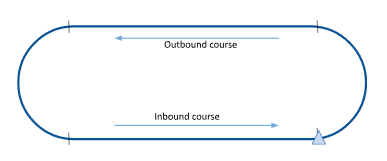
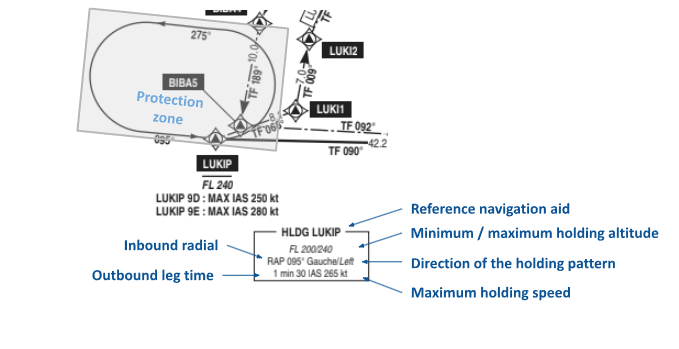
A holding pattern is therefore made up of two 180° turns connected by two straight legs (an inbound leg and an outbound leg). It has a direction (Left or Right) indicating the direction of the turn on the inbound section, and a flight time or distance to be flown on the straight sections.
Example:
¶ When are holding patterns used?
¶ High traffic volume
In certain situations, it happens that a very high traffic load cannot be managed properly without delaying certain traffic. It is therefore necessary to place aircraft in a holding pattern in order to facilitate the management of traffic flows.
¶ Emergencies, Failures & Weather
When an emergency is declared at an airport with a single runway, no other traffic must land on it before the aircraft in distress. Other aircraft on approach may therefore have to wait.
Also, in the presence of a storm or difficult weather near the airfield, it is possible that traffic may temporarily be unable to land there. They will therefore have to wait before being able to attempt a landing.
¶ Altitude loss
In cases where a pilot is well above the initial descent path, it is possible for them to continue their descent safely within a holding pattern. This alternative allows altitude to be lost without having to vector the aircraft by radar in order to lengthen its approach.
¶ Sequencing
In certain situations, particularly at airfields where air traffic control is only provided in a "procedural" manner, the only solution allowing several traffics to be sequenced remains the use of holding patterns.
¶ How to manage a stack
¶ Entering the hold
¶ Published hold
"Published" holding patterns are those shown on charts. Their characteristics are therefore specified there. The pilot must therefore precisely follow the instructions indicated on the chart when the controller asks them to hold. Depending on their workload, the controller can also indicate the estimated holding time or the expected approach time to the pilot.
¶ Unpublished hold
The air traffic controller can also ask a traffic to hold at a fix where no pattern is published. The holding clearance must then be supplemented with the information that would normally be found on a chart. For example, the inbound radial, the direction of the pattern, the distance or flight time on the outbound radial. This clearance automatically requires greater vigilance regarding the impact on and monitoring of flows, since the traffic operates within an area protected solely by radar surveillance. These non-standard holds thus add a significant workload for the controller but are sometimes necessary if the published holds are completely saturated.
When you instruct holds, it is essential to have the aircraft you place there reduce speed. In approach control, it is preferable in this situation to ask the pilot for a "minimum holding speed", that is to say a speed whose value is almost equivalent to the minimum clean speed.
¶ The different entry procedures
There are several procedures for entering a holding pattern depending on how the fix is approached. These procedures are designed so that the traffic operates within the holding pattern's protected area while repositioning itself in the correct direction.
¶ Direct entry
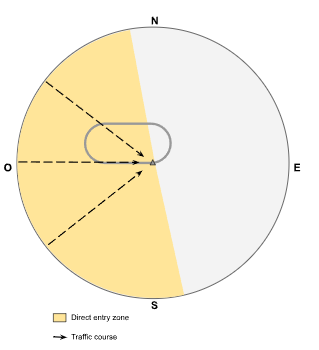
Direct entry is the most common. It is used when the traffic arrives on the same axis as the inbound radial. It simply consists of following the first turn of the racetrack pattern.
¶ Parallel entry
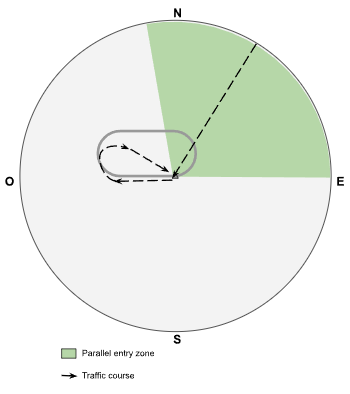
Parallel entry is used when the traffic arrives facing the fix and on the holding side. The traffic then passes overhead the fix, flies outbound on the track of the inbound axis before making a U-turn to return to the fix and begin the hold.
¶ Entrée décalée
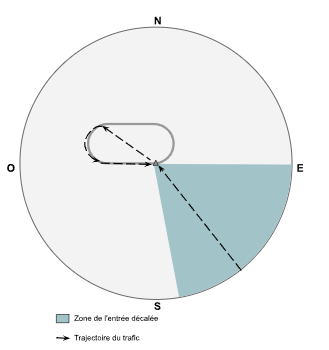
L'entrée décalée est utilisée lorsque le trafic arrive face au repère et du côté opposé de l’attente. Il passe alors verticale du repère puis continue sur la course d'éloignement avant de suivre le virage de l’attente pour revenir sur le repère et débuter celle-ci.
¶ Descending within the hold
Holds are located within RVSM airspace (or below flight level 290 if they are not en-route holds), so traffic can operate there with a minimum of 1000ft vertical separation. However, care must be taken to maintain this separation when they are in vertical evolution within the hold. It is recommended, when frequency time is limited, to only clear a traffic to descend once the level below has been vacated.
Examples:
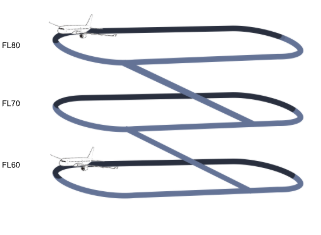
In the example above, the traffic at level 80 can be cleared to descend to level 70, since the traffic located below it is at level 60.
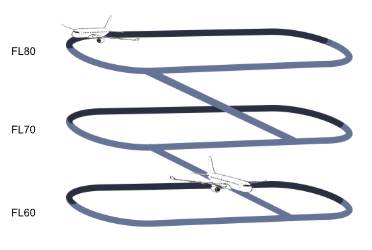
In the example above, the traffic at level 80 cannot be cleared to descend to level 70, since level 70 is still occupied by the preceding traffic.
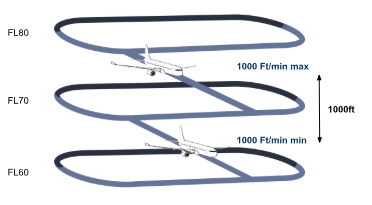
In order to save time when descending traffic, it is also possible to assign them a fixed rate of descent making it possible to maintain vertical separation.
¶ Exiting the hold
¶ Immediate exit
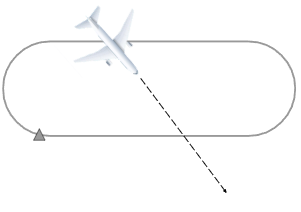
This clearance is given by means of a heading or a direct routing and implies that the traffic immediately follows the new instructions, regardless of its position within the holding pattern.
¶ Anticipated exit
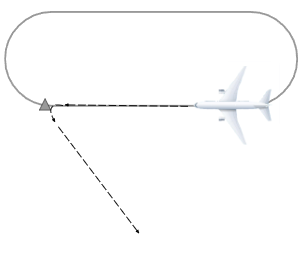
Unlike the immediate exit, this clearance implies that the traffic finishes the racetrack pattern it is currently in and only leaves the pattern at the next pass over the fix. Upon passing the fix, the traffic will follow the instructions given by control; if the hold is located on an IAF / IF with a published track toward the approach, then this clearance can be supplemented with an approach clearance.
¶ Coordination between controllers
In the case of holds being put into use at a sector boundary (e.g. APP/F_APP), it is necessary to coordinate on the strategy for delivering traffic, to ensure a smooth and safe flow.
There are two strategies:
- The initial approach (in charge of the stack) has the traffic exit the hold with a heading and, if applicable, a descent, then hands them off (shoots them) to the ITM.
- The lowest traffic in the stack is handed off (shot) to the ITM, who will be responsible for its exit from the hold.