¶ Speed control
¶ The different speed units
¶ Indicated Airspeed (IAS)
Indicated airspeed (or Indicated Air Speed) is the speed displayed on the instruments on board the aircraft. This value is obtained by the probes installed on the aircraft. The measurements taken by these probes are transmitted to the instruments.
¶ True Airspeed (TAS)
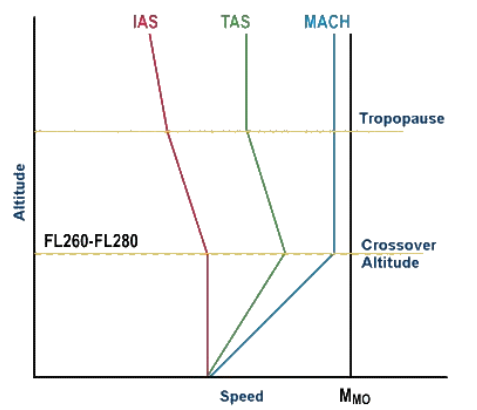
True airspeed (or True Air Speed) is the speed at which the aircraft moves through the air mass, regardless of its density. This naturally increases during the climb due to a decrease in air resistance. Indeed, the higher you climb, the lower the pressure; thus, for the same thrust, an aircraft will have a greater true airspeed at high altitude than in the lower layers.
It is often indicated by the instruments of aircraft equipped with onboard computers. Nevertheless, one can simply determine an approximate value as follows:
Example: An aircraft flying with a tailwind will have a GS > its TAS; an aircraft flying into a headwind will have a GS < its TAS; an aircraft flying with a crosswind will have a GS = its TAS.
¶ Mach speed
The Mach number is an aircraft's true airspeed expressed as a percentage of the speed of sound. It is only used in en-route control. From flight level 260 (approximately) onward, it can be calculated using the following relation:
Example: An aircraft flying at FL360 with a TAS of 450kts will have a Mach speed of 450/600 = 0.75. It will be said to be flying at Mach point 75.
¶ Reference speeds on approach
¶ Minimum clean speed
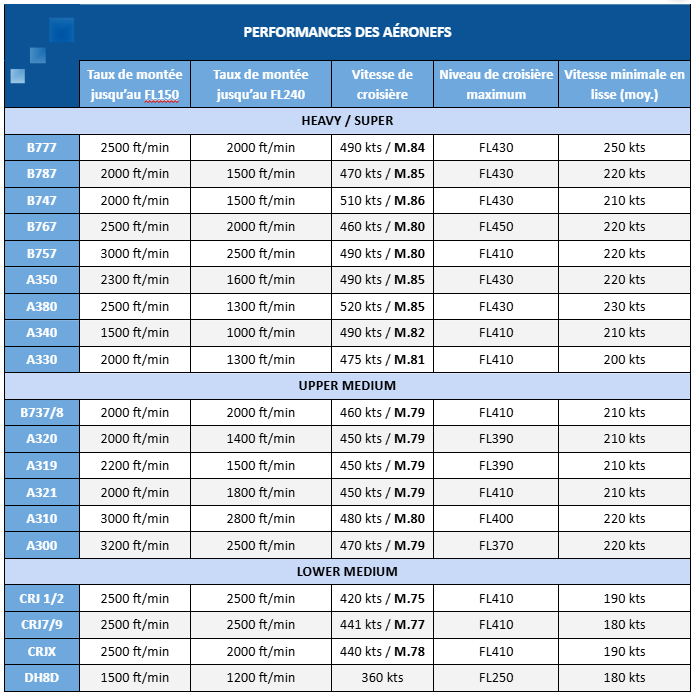
Minimum clean speed (or minimum clean speed) is the lowest speed at which an aircraft can operate without deploying high-lift devices (flaps, …). It thus makes it possible to indicate reductions in indicated airspeed to around 220 knots without penalizing the crew with the deployment of equipment that introduces drag.
Example: Minimum clean speed can notably be used when a traffic is placed in a holding pattern.
¶ Minimum approach speed
Minimum approach speed is the speed at which an aircraft flies on final approach. It generally corresponds to 130% of the aircraft's stall speed: (vAPP = 1.3 x vSTALL). It therefore depends on the type of aircraft.
¶ Cruise speeds
¶ Climb / descent speeds
As seen previously, different speed units change depending on altitude.
In order to maintain a constant speed, it is necessary to carry out a speed conversion.
The altitude at which this conversion takes place is called the "crossover altitude" and depends in particular on weather conditions: it is generally found between FL260 and FL290.
Below these levels, the aircraft will maintain an indicated airspeed, whereas above, it will maintain a Mach number.
¶ Cruise speed
In cruise, without taking wind into account, for two aircraft maintaining the same Mach number, the one at the lower altitude will be the faster, at a rate of ~2kts per 1000ft.
Example: at M.80, at FL260 -> 467kts; at FL360 -> 447kts). For two aircraft maintaining the same indicated airspeed, the one at the higher altitude will be the faster.
¶ Manipulating the different speeds
¶ In approach control
¶ Speed restriction
Speed restrictions allow the approach controller to maintain or slow down an aircraft to a certain speed in order to achieve various objectives (separation maintenance, sequencing, …). The speeds mainly used here will generally be between 280kts and 180kts.
The maximum speed for intercepting an approach procedure is generally 220kts.
In approach control, the use of speeds does not make it possible to create separation between two aircraft. For this, the use of guidance (vectoring) is instead preferred. Speeds are only intended to allow the maintenance of an already existing separation.
Note that generally, a standard reduction requires approximately 1 nm to lose about ten knots.
An aircraft can hardly lose altitude and speed at the same time, so it is necessary to structure your guidance so as not to need an aircraft to reduce sharply while it also has to descend.
Furthermore, a clearance for the approach cancels all prior restrictions if they are not specified within the same clearance
Example: …maintain 180kts until 6 nautical miles final…
¶ Regulation on final approach
In order to avoid any catch-up and/or loss of separation on final approach, speed restrictions associated with distances can be used. They are used so that an aircraft reduces its speed so as not to catch up with the preceding one, but also to maintain a traffic at a high speed to prevent the following one from catching up with it.
The most commonly used restrictions are 200kts until 8nm, 180kts until 6nm, 160kts until 4nm and 140kts until 2nm.
¶ In en-route control
¶ Mach speed regulation
In en-route control, in order to preserve separation or to regulate a flow, the controller can restrict aircraft by using Mach speeds. In certain cases, the speed restriction here also allows the creation of separation.
A difference of one Mach point corresponds to a difference of approximately 6kts in the true airspeed of two aircraft at the same level. Moreover, we know that a difference of 6kts corresponds to a gain or loss of 1 nm in 10 minutes.
¶ Speed conversion during climb / descent
As indicated previously in the document, traffic in vertical evolution undergoes a speed conversion, so it is necessary to adapt the restriction accordingly. In this case, the controller can indicate a restriction by adding, in the clearance, the notion of "conversion" indicating the maintenance of the new restriction from the crossover altitude onward.