
¶ Air Traffic Flow and Capacity Management (ATFCM)
¶ Overview
Air Traffic Flow and Capacity Management (ATFCM) balances forecast traffic demand against the available capacity of aerodromes and airspace sectors.
ATFCM measures are used to:
- Prevent aerodromes and sectors from exceeding their declared capacity;
- Maintain a safe, orderly and efficient traffic flow;
- Reduce controller workload and traffic complexity; and
- Distribute unavoidable delay as efficiently as possible across the network.
¶ Controller Responsibilities
CTOT compliance
Controllers shall comply with all applicable CTOTs, regardless of whether A-CDM procedures are in use at the departure aerodrome.
When handling a regulated flight, ATC shall:
- Take account of the assigned CTOT when issuing clearance and start-up approval;
- Assist the flight in meeting its CTOT where operationally possible; and
- Ensure that take-off occurs within the applicable CTOT tolerance window.
¶ Capacity
¶ Aerodrome Capacity
Aerodrome capacity is the number of arrivals and departures that an airport can safely and efficiently handle during a specified period. It represents the declared operational capacity, not the airport’s absolute physical limit.
Capacity is not fixed and may change throughout the day according to:
- The active runway configuration and the balance between arrivals and departures.
- Runway occupancy times and wake-turbulence separation.
- Available arrival, approach, and departure procedures.
- Weather conditions, including wind, visibility, cloud base, and thunderstorms.
- The activation of low-visibility procedures.
- Taxiway, apron, stand, or runway restrictions.
- ATC staffing, sector workload, and coordination with adjacent units.
- Temporary closures, works, or other operational restrictions.
¶ Reading the Capacity Display
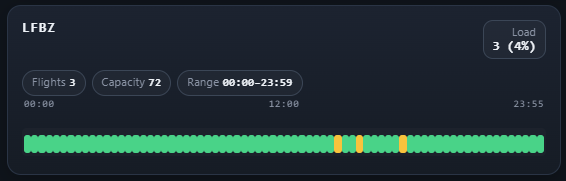
The capacity display compares the expected traffic demand with the declared capacity for the selected aerodrome and time range.
In the example shown:
- Flights 3 — Three flights are included in the displayed period.
- Capacity 72 — The configured capacity for the selected period is 72 movements.
- Load 3 (4%) — Three of the 72 available movements are currently used, representing approximately 4% of the declared capacity.
- Range 00:00–23:59 — The display covers the complete operational day.
- Timeline — Provides a visual overview of capacity across the selected period. Highlighted sections indicate periods where the declared capacity changes or requires closer attention.
The display allows controllers and flow managers to identify potential periods of congestion before they become operationally significant.
When forecast demand exceeds the available capacity, an Air Traffic Flow and Capacity Management (ATFCM) measure may be introduced. Depending on the situation, this may include departure restrictions, regulated arrival rates, CTOT allocation, ground delay, or tactical rerouting.
The objective is to balance demand with the airport’s available capacity and prevent excessive airborne holding, ground congestion, and controller workload.
¶ En-Route Sector Capacity
En-route sector capacity is the amount of traffic that a sector can safely and efficiently manage during a specified period. It is based not only on the number of aircraft, but also on the expected controller workload and traffic complexity.
Sector capacity may be defined using:
- Entry rate — The maximum number of aircraft that may enter the sector during a specified period.
- Sector occupancy — The maximum number of aircraft that may be inside the sector at the same time.
- Combined capacity — A limit based on both entry rate and sector occupancy.
¶ Reading the Capacity Display
The sector capacity display compares forecast traffic with the declared capacity of the selected sector.
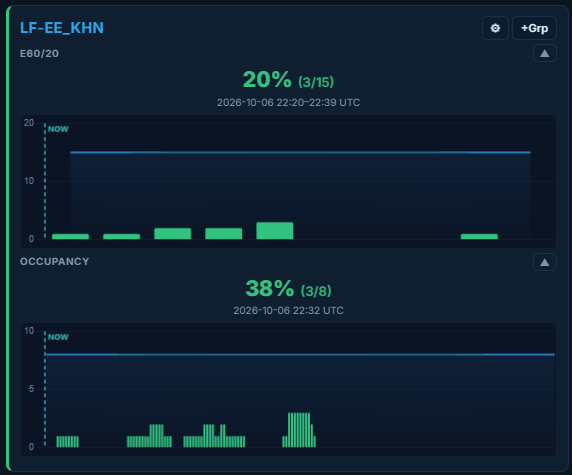
In the example shown:
- LF-EE_KHN — The selected sector or sector group.
- 20% (3/15) — Three aircraft are expected to enter the sector during the displayed period, against an entry capacity of 15.
- 38% (3/8) — Three aircraft are expected to be inside the sector simultaneously, against a maximum occupancy of eight.
- Green bars — Show the forecast traffic demand over time.
- Horizontal blue line — Shows the declared capacity limit.
- NOW — Indicates the current time within the forecast.
The entry-rate graph helps identify periods with a high number of incoming aircraft. The occupancy graph shows how many aircraft are expected to be inside the sector at the same time.
A sector may remain below its occupancy limit while still receiving too many aircraft within a short period. For this reason, both values must be monitored together.
¶ Factors Affecting Sector Capacity
The available capacity may change according to:
- The active sector configuration and whether sectors are combined or split.
- Controller staffing and workload.
- Weather deviations or unavailable routes.
- Military activity and temporary reserved airspace.
- Traffic direction, convergence, climbing and descending profiles, and aircraft performance.
- Coordination requirements with neighbouring sectors.
- Technical or operational restrictions.
A high percentage does not automatically mean that the sector is overloaded, but it indicates that less capacity remains available for additional or unexpected traffic.
When forecast demand exceeds the declared capacity, flow-management action may be required. This may include splitting sectors, balancing traffic between routes, applying level restrictions, rerouting aircraft, or introducing an ATFCM regulation.
The available sector capacity may vary according to weather, staffing, military activity, traffic complexity and the active sector configuration.
¶ ATFCM Regulations
An ATFCM regulation may be introduced when forecast demand is expected to exceed the available capacity of an aerodrome or airspace sector.
A regulation limits the number of flights entering the affected resource during a specified period. Departure times may therefore be adjusted to distribute demand and minimise overall network delay.

¶ Calculated Take-Off Time
A flight affected by a regulation may be assigned a Calculated Take-Off Time (CTOT). The CTOT represents the departure slot allocated to the flight.
Holding the aircraft on the ground until its allocated departure window reduces airborne holding and prevents additional congestion at the regulated location.
¶ CTOT Compliance
The applicable CTOT tolerance window is:
CTOT −5 minutes to CTOT +10 minutes
For example, an aircraft with a CTOT of 1930 UTC shall take off between 1925 UTC and 1940 UTC.
Operational requirement
ATC shall not permit a regulated flight to take off outside its CTOT tolerance window. If the flight cannot comply, a revised CTOT shall be obtained before departure.
¶ Relationship with A-CDM
A CTOT is a network constraint, whereas a TTOT is the take-off time produced by the local airport departure sequence. The two times serve different purposes and shall not be treated as interchangeable.
At an A-CDM aerodrome, the CDM system integrates the CTOT into the local departure sequence. It considers the expected taxi-out time (EXOT), runway capacity, start-up delay and any additional operational time to calculate a TSAT intended to bring the aircraft to the runway within the CTOT tolerance window.
At a non-A-CDM aerodrome, no TSAT is calculated. The controller instead plans start-up and pushback from the CTOT, its tolerance window and the expected taxi time.
In both cases, the currently assigned CTOT remains applicable until the ATFCM system revises or cancels it.
¶ Readiness and Slot Revision
A Ready (REA) message informs the ATFCM system that a regulated aircraft is fully ready to depart. It may allow an earlier CTOT to be allocated if capacity becomes available, but it does not cancel the current CTOT and does not authorise departure outside the current tolerance window.
If a flight can no longer depart within its CTOT tolerance window, its planning information shall be updated and a revised CTOT obtained before take-off. The operational method for submitting a ready message or requesting a new CTOT depends on whether the departure aerodrome uses A-CDM procedures.
¶ Short-Term ATFCM Measures
In addition to CTOT-based regulations, short-term ATFCM measures may be used to manage unexpected demand, reduce controller workload or limit traffic complexity.
Within the VATSIM European network, cross-border measures are coordinated through the European Collaborative Flow Management Programme (ECFMP).
Common measures include:
- Level capping;
- Rerouting or mandatory routing;
- Minimum Departure Intervals (MDIs);
- Average Departure Intervals (ADIs);
- Miles-in-Trail restrictions;
- Speed restrictions or adjustments; and
- Ground stops.
Minimum Departure Interval
When an MDI is implemented through the ATFCM system, affected departures may receive CTOTs that provide the required spacing at source. This prevents excess traffic from reaching the runway holding point or affected airspace at the same time.
¶ ATFCM Messages and Status Codes
For network-standard CTOT procedures and message definitions, refer to the EUROCONTROL ATFCM Users Manual.