
¶ Introduction
The purpose of this document is to set out the rules and procedures to be followed by French vACC controllers or any person wishing to undertake the ATC training programme with a view to obtaining an ATC rating on the VATSIM simulation network.
Any use or adaptation (even partial) outside the context of French vACC is strictly prohibited without the written approval of the ATC Training Director (French vACC Training Director).
If you have any questions, please contact us directly via a support ticket on the French vACC Discord server, or by email at atc@vatsim.fr
¶ Enforcement
These regulations came into force on Sunday 4 January 2026 at 00:01 UTC. These regulations are consistent with and supplement the “VATEUD Division Policy” and the “VATSIM GCAP”. The VATSIM GCAP is available here.
¶ Prerequisites
To take part in air traffic control activities at French vACC, you will need a Discord account and a VATSIM account. These two accounts must be linked via the vACC website for the duration of your participation.
¶ Operations
¶ Roster
The term “roster” refers to the list of air traffic controllers authorised to work across a range of positions. This list is available at core.vateud.net and is maintained by the ATC Training Department[1]. This is the official list and is the sole authoritative source.
¶ Retaining qualification
A minimum of 5 hours of monitoring per rolling 6-month period in one of French vACC’s monitoring roles is required to maintain “approved monitor” status. The monitor must also keep up to date with procedures.
Keeping up to date involves:
- Reading the French vACC SOPs, available in the Documentation section of the website,
- Acknowledging that significant changes have been read,
- Completing theoretical quizzes where necessary.
Failure to meet these requirements, serious shortcomings in the quality of service or a serious lack of knowledge of procedures may result in the revocation of the qualification and lead to the air traffic controller being removed from the roster. In exceptional circumstances, the ATC Training Department is authorised to decide on a case-by-case basis.
This also applies to visiting-controllers.
¶ Platform Categorization
In accordance with the aforementioned regulations, French vACC has categorized French airports into several categories detailed below.
¶ Unrestricted Classification
Opening prerequisites:
The controller must be listed on the roster and hold the status of "approved controller".
Before opening an unrestricted position, the controller must have studied and become familiar with the relevant airport. Whenever available, the SOP (Standard Operating Procedures) MUST be read, understood, and applied. Where applicable, a quiz or simulation session may be required.
Any person holding at least an S1 rating and listed on the roster may freely control these platforms.
¶ S1 Towers
Certain Tower (TWR) positions have been designated as S1 Towers.
These positions are:
LFRS_TWR | LFLS_TWR
These positions are considered unrestricted for ATCs qualified as S2 and above.
To open these positions as an S1, you must have:
- Completed a minimum of 50 hours of ATC on GND positions,
- Completed the theoretical part of the S2 training syllabus, and
- Be part of the S1 Tower approved ATC list.
¶ Tier 1 Classification
Positions classified as "Tier 1" are control positions requiring specific training and/or experience.
Qualification Process
To apply for a Tier 1 qualification, the controller must not currently be undergoing training toward a higher rating or another Tier 1 or Tier 2 qualification.
Opening Prerequisites:
Before opening a Tier 1 position, the controller must have completed training provided by the ATC Training Department. This training consists of both theoretical and practical sessions (typically around three sessions on average). Once the training has been completed and validated, the qualification is issued.
Qualification Maintenance:
A minimum of 5 hours of controlling within any rolling 6-month period on one of the positions within the group is required to maintain the corresponding qualification. Controllers must also remain current with applicable procedures.
Remaining current includes:
- Reading French vACC SOPs available in the Documentation section of the website,
- Acknowledging significant procedural changes,
- Completing theoretical quizzes where required.
In exceptional cases, the ATC Training Department may assess individual situations on a case-by-case basis.
This also applies to visiting-controllers.
The detailed list of Tier 1 and Tier 2 positions and/or airports is available via this link.
¶ Tier 2 Classification
Tier 2 airports are airports featuring characteristics outside the standard training curriculum.
Qualification Process
To apply for a Tier 2 qualification, the controller must not currently be undergoing training toward a higher rating or for a Tier 1 qualification.
Opening Prerequisites:
Before opening a Tier 2 platform, the controller must have completed theoretical training provided by the ATC Training Department. Successful completion of a knowledge assessment confirms that the trainee possesses the theoretical foundation required to operate the platform. One mentoring session (maximum) may also be provided as a supplement.
Qualification Maintenance:
There is no minimum hourly requirement to maintain the qualification. However, the controller must remain current with applicable procedures.
Remaining current includes:
- Reading French vACC SOPs available in the Documentation section of the website,
- Acknowledging significant procedural changes,
- Completing theoretical quizzes where required.
In exceptional cases, the ATC Training Department may assess individual situations on a case-by-case basis. This also applies to #visiting-controllers.
The detailed list of Tier 1 and Tier 2 positions and/or airports is available via this link.
¶ Activity Review
At least once per year, French vACC verifies that all controllers listed on the roster meet the minimum activity requirements described in the "Qualification Maintenance" section.
During an activity review, ATCs who do not meet qualification maintenance requirements will receive an email from the ATC Training Department. This email will inform them of their status and provide 30 days to complete the controlling hours required to maintain their qualification.
If, after 30 days, an ATC still does not meet the activity requirements, the ATC Training Director (ATC TD) will notify them by email and remove them from the roster. If only Tier 1 and/or Tier 2 qualification requirements are not met, the corresponding qualifications will be removed while the controller remains on the roster. The ATC TD will notify the affected controller accordingly.
ATCs who have been listed on the roster for less than six months at the time of the activity review are exempt from this process.
¶ Traffic Flow Positions / Coordinator / Organic Controller
A "Traffic Flow" position (_TMU or _FMP) does not provide any service directly to pilots. Its sole purpose is to anticipate, prepare, coordinate, and, when necessary, implement traffic flow measures.
These positions may only be opened during events where such a need has been identified in advance or with authorization from the ATC Training Department. During events, these positions are subject to roster assignment.
Four coordinator roles are typically identified:
- DEL
- Callsign:
XXXX_D_FMP
- Callsign:
- Tower
- Callsign:
XXXX_T_FMP
- Callsign:
- Radar
- Callsign:
XXXX_A_FMP
- Callsign:
- En-route
- Callsign:
XXXX_FMP
- Callsign:
Their responsibilities include, but are not limited to:
- Monitoring slots (CTOT, TSAT, etc.),
- Preparing clearances,
- Implementing and monitoring flow measures,
- Implementing and recommending holding management solutions,
- Coordinating with adjacent controllers,
- Anticipating traffic flows and their management.
| Position | Minimum Rating |
|---|---|
| DEL Coordinator | S2 |
| Tower Coordinator | S3 |
| APP Coordinator | C1 |
| En-route Coordinator | C1 |
If the positions are designated as Tier 1, the controller must hold the corresponding qualification.
A theoretical training course grants the qualification required to open one of these positions. Practical application is conducted through coaching.
¶ ATC Training
¶ Prerequisites
Training does not require any prior aeronautical knowledge. Nevertheless, a general aviation background and pilot experience on the network are significant advantages that will facilitate the training process. In accordance with VATSIM regulations, all students must be able to communicate, coordinate, and provide air traffic control services in English.
The training process requires discipline as well as a sustained commitment over time. The process is a marathon, not a sprint. Students should expect to dedicate, on average, one evening per week to training. A pace of two sessions per week is ideal. Personal study and self-training will also be expected.
¶ General Training Process
French vACC trains VATSIM members wishing to control on the network for all ratings requiring formal training, in chronological order:
-
S1 Rating (Ground Controller)
This rating allows controllers to operate DEL and GND positions and, under certain conditions, specific TWR positions as defined in S1 Towers, depending on any applicable restrictions. For more information, refer to the Platform Categorization section.
-
S2 Rating (Tower Controller)
This rating allows controllers to operate DEL, GND, and TWR positions, subject to any applicable restrictions. For more information, refer to the Platform Categorization section.
-
S3 Rating (TMA Controller)
This rating allows controllers to operate positions available to the previously mentioned ratings, as well as APP and DEP positions, subject to any applicable restrictions. For more information, refer to the [Platform Categorization](#platform categorization) section.
-
C1 Rating (Enroute Controller)
This rating allows controllers to operate positions available to the previously mentioned ratings, as well as CTR positions, subject to any applicable restrictions. For more information, refer to the Platform Categorization section.
¶ Progression to the Next Rating
To begin training toward a higher ATC rating, a student must have accumulated at least 50 hours of controlling on the highest unrestricted position they are authorized to open.
Example: Before beginning C1 training, a student must have accumulated 50 hours as an S3 on approach positions (_APP).
Students must not be undergoing training for a Tier 1 or Tier 2 qualification. Such qualifications must be completed before training toward the next ATC rating can begin (see Tier 1 classification and Tier 2 classification.
As part of a C1 training application, the ATC Training Department may organize one or more sessions on an approach position to assess the student's abilities.
¶ Skills Assessment
Before being eligible to take the practical examination for the next rating, students must pass a theoretical examination covering the knowledge required for that rating.
Any proven attempt to cheat during a theoretical or practical examination will result in immediate suspension of training without prior notice and a report to VATEUD. French vACC reserves the right to take additional measures, including against any person who contributed to the cheating attempt.
¶ Training Airports
"Training airports" are airports where S2 and/or S3 controller training may be conducted. S1, S2, and S3 training is carried out exclusively at these airports.
The designated training airports are:
- Toulouse-Blagnac (LFBO)
- Marseille-Provence (LFML)
- Lyon Saint-Exupéry (LFLL)
- Nice Côte d'Azur (LFMN) [2]
For C1 training, the training positions are LFEE (Reims ACC) and LFBB (Bordeaux ACC).
Students may freely choose between Toulouse-Blagnac (LFBO), Marseille-Provence (LFML), and Lyon Saint-Exupéry (LFLL) for their training. This choice is fixed and final for each training level. Nice Côte d'Azur (LFMN) may be proposed by the ATC Training Department on a case-by-case basis. For C1 training, exceptions may be granted. In all cases, the ATC Training Department has final authority.
¶ Training Curriculum
A complete training flowchart is available in the documentation section of the website:
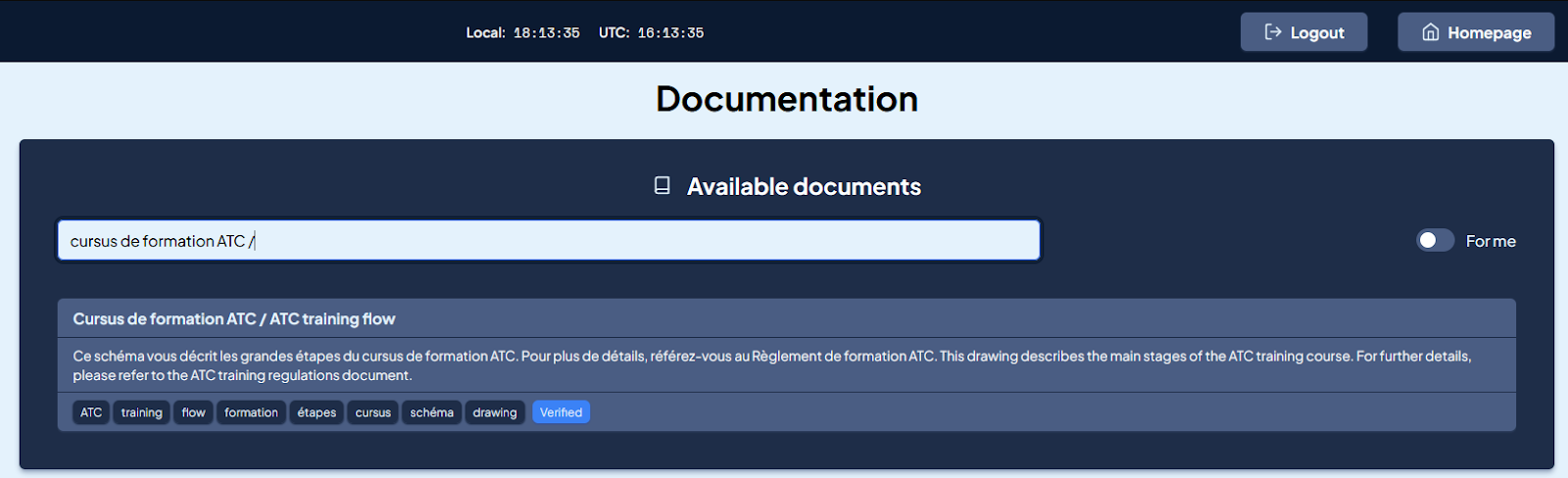
This regulation provides additional details regarding the stages described in that document.
¶ Access to the Ab Initio Course
Once a candidate holds an OBS rating and is not affiliated with another subdivision, they are granted access to the course identified on the training platform.
As part of self-study, the candidate:
- Learns about the structure and operation of the VATSIM network and French vACC,
- Completes an introductory aeronautical knowledge module,
- Installs, explores, and tests the software required for online controlling.
As with any training program, an observation phase is beneficial. Although not mandatory, this phase of initial learning is strongly recommended. Candidates are encouraged to connect to the network as observers, become familiar with the tools, and ask questions. Their chances of success will only improve if this time is used effectively.
Candidates will be assessed through quizzes covering the theoretical material provided. Passing these quizzes is required to continue the training program. French vACC reserves the right to impose waiting periods before a candidate may retake a quiz.
Upon completing this course and successfully passing the theoretical requirements, the candidate may request placement on the waiting list for practical training.
¶ Waiting List
Candidates awaiting training are placed on a waiting list. Priority is assigned in descending order as follows:
- Students awaiting a CPT[3],
- Students currently undergoing training (for their current rating),
- Students awaiting training for a new rating,
- Students awaiting initial training.
Requests are processed in chronological order. French vACC may exceptionally deviate from this rule for operational reasons.
Time spent on the waiting list varies depending on:
- Mentor availability,
- The number of pending training requests,
- The time of year,
- The candidate's commitment,
- The candidate's behavior and compliance with applicable rules, including courtesy, the VATSIM Code of Conduct, and Discord server rules.
Waiting times are difficult to predict. Candidates are asked not to repeatedly contact staff regarding estimated delays. During this period, they are encouraged to broaden their aviation knowledge and become actively involved in the network and within French vACC.
Once a student requests placement on the waiting list following completion of the Introduction course, they may view their position on the waiting list. Should they request removal from the waiting list, they acknowledge that their progress will be lost and that their place will be given to the next candidate in line.
¶ Removal from the Waiting List
A candidate may be removed from the training waiting list for any of the following reasons:
- The candidate has left the French vACC Discord server [4],
- The candidate has been banned from the French vACC Discord server,
- The candidate's VATSIM account has been suspended or has become inactive,
- The candidate has transferred to another vACC,
- The candidate has failed to respond to a training offer within four weeks [5],
- The candidate has been removed from the list of approved ATC controllers.
¶ Access to Training Programs
French vACC regularly opens new training slots. The objective is to ensure an appropriate availability of mentors and examiners throughout the training process.
When a training slot becomes available, candidates from the initial waiting list will be contacted according to the procedures described in the Waiting List section.
¶ S1 Theoretical Test
A theoretical test (in English) is required to obtain the first controller rating (S1). This rating allows controllers to open _DEL and _GND positions at unrestricted airports and training airports.
Opening a _TWR position with this rating is only permitted on the designated training airport (see Training Airport and only after receiving a solo endorsement. It is also permitted under the provisions of S1 Towers.
Candidates will be given several days to complete an online questionnaire assessing their knowledge of basic aviation concepts, the VATSIM network, and its regulations.
If successful, the student proceeds to the next stage. If unsuccessful, they must wait five days before retaking the test. The same delay applies if the test is not completed within the allotted time.
¶ Practical Training
You will be supervised by one or more mentors during key stages of your training.
Once a mentor has been assigned and initial contact established, the mentor will schedule multiple control sessions with you, both in simulation and on the live network. To make the most of these sessions, students are expected to demonstrate commitment, curiosity, and initiative.
¶ Solo Endorsement
Once the training program for the rating has been completed, the material mastered, and sufficient experience gained, the mentor may grant the student a "solo endorsement".
This means that for a limited period (30 days, renewable once), the student will be authorized to control independently at their training airport. During this period, they are expected to control regularly (ideally two to three times per week). The solo endorsement may be revoked at any time.
Important: Students should be aware that the vACC cannot grant more than 60 cumulative days of solo endorsement. As such, students must ensure they are available to make full use of their solo period.
¶ Practical Examination (CPT)
The purpose of this session is to assess the student's skills.
Upon successful completion, the Training Director will submit the request for promotion to the next ATC rating.
If the student fails the CPT, they will return to the practical training phase with a mentor. Additional sessions may be organized before a new examination attempt. Before this final attempt, an additional 30 days of solo endorsement may be granted if the initial 60 days have already been used.
A minimum number of examiners is required to conduct a CPT:
| Rating Examined | vACC Examiners | Division Examiners |
|---|---|---|
| S2 | 1 | 0 |
| S3 | 2 | 0 |
| C1 | 2 | 0 |
For a C1 examination, if an insufficient number of vACC examiners is available, the ATC Training Department may request the assistance of a Division examiner (VATEUD). The examination may also be postponed to a later date.
To ensure fair assessment, examiners must hold the minimum ratings listed below:
| Rating Examined | Minimum vACC Examiner Rating |
|---|---|
| S2 | S3 |
| S3 | C1 |
| C1 | C1 |
¶ Responsibilities and Expectations
French vACC expects its students to:
- Be available and committed to their training over time,
- Notify the ATC Training Department of periods of unavailability,
- If the period of unavailability becomes prolonged, training may be suspended,
- Understand and respect the commitment made by mentors,
- Understand that training is not an entitlement,
- Arrive on time for mentoring sessions,
- Contact their mentor as quickly as possible in the event of unforeseen circumstances,
- Attend mentoring sessions prepared, including a list of questions where appropriate,
- Understand and accept that repeated absences, repeated late cancellations, lack of commitment, breaches of the VATSIM Code of Conduct or vACC regulations, or inappropriate behavior may result in training being terminated.
¶ Fast-Track Procedure
The Fast-Track procedure is available to controllers active on the IVAO network who hold an APC or ACC rating (or higher). This procedure allows them to apply respectively for an S2 (Tower) or S3 (Approach) rating. This is NOT an automatic or immediate equivalency process.
The purpose of this procedure is not to train controllers from scratch, but rather to provide a concise introduction to the tools used within French vACC and to verify existing competencies.
- Submit an application through a support ticket on the French vACC Discord server.
- The candidate is granted access to a course on the training platform. They may then independently study the tools, LoAs, procedures, and regulations applicable within French vACC.
- The candidate is assessed on the provided theoretical material.
- If successful, a practical session is conducted in Sweatbox:
- For an S2 Fast-Track, the session is conducted on a Tower position (chosen by the student from among the designated training airports). This session is not an examination; the mentor will simply ensure that the candidate demonstrates the minimum required competencies.
- For an S3 Fast-Track, the session is conducted on an Approach position.
- If the Sweatbox session is satisfactory, an online session with a mentor is organized on the same platform.
- If the online session is satisfactory, the Fast-Track application is submitted to VATEUD together with the candidate's IVAO profile.
- VATEUD reviews the Fast-Track application. The request is either approved or rejected.
- If approved, the candidate completes a theoretical examination corresponding to the requested rating.
- If the theoretical examination is passed, French vACC may submit its recommendation to VATEUD.
- The student is awarded the rating for which the Fast-Track application was submitted.
Holders of a European Air Traffic Controller License are also eligible for this procedure.
¶ Visiting Controllers
VATSIM allows controllers holding an S3 rating or higher to apply to control occasionally within a vACC other than their home subdivision. In accordance with the VATSIM Transfer & Visiting Controller Policy (TVCP), French vACC offers a dedicated pathway for S3 and higher-rated controllers wishing to do so.
The process is as follows:
- Submit an application through a support ticket on the French vACC Discord server.
- The candidate is granted access to a course on the training platform. They may then independently study the tools, LoAs, procedures, and regulations applicable within French vACC.
- The candidate is assessed on the provided theoretical material.
- If successful, a session is conducted with a mentor. It consists of two parts:
- An introduction to the tools in Sweatbox;
- A one-hour online session on the selected position.
- If the session is satisfactory, the candidate is added to the roster and may freely control all unrestricted positions.
For an S3 candidate, the session is conducted on an Approach position (_APP). For a C1 candidate, the session is conducted on a Centre position (_CTR).
Remarks: In accordance with Section 6.1.b of the TVCP, French vACC will reject any application from a controller who cannot demonstrate at least 50 hours of controlling on the highest unrestricted position they are authorized to open within their home vACC.
Example: A visiting controller holding a C1 rating must demonstrate at least 50 hours of controlling as a C1 on en-route (_CTR) positions.
French vACC also reserves the right to reject any applicant who has been subject to disciplinary action on the network within the year preceding their application (Section 6.1.d of the TVCP).
ATC Training Department: refers to the training team. This comprises the mentors, as well as the Training Director and his Deputy. ↩︎
Tier 1 airport, available only upon approval by the ATC Training Department. ↩︎
CPT: Controller Practical Test, the practical examination required to obtain an ATC rating. ↩︎
The ATC Training Department will contact the candidate. If they confirm they are no longer interested, or if no response is received within seven days, they will be removed from the waiting list. ↩︎
The ATC Training Department will send a reminder after two weeks. If no response is received, removal from the waiting list becomes effective. ↩︎