
¶ Instrument departure procedures
There are two types of departures for IFR traffic departing a controlled aerodrome.
¶ Standard departure
The standard departure, also called a Standard Instrument Departure (SID), consists of a published track using RNAV fixes or radio navigation aids. This procedure is the most common since it is designed to limit conflicts and allows a protected area to be maintained with respect to terrain.
The SID has two subcategories, qualifying its type of track and therefore the equipment required to use it.
The SID has a specific naming convention. It will always be constructed according to the following structure:
-
first en-route point, in other words the last point of the SID: in our example IRMAR
-
version number: in our example 7
-
configuration letter: in our example A
Procedures must be reviewed periodically (equipment changes, tracks, constraints, etc). To mark this change, the version number is incremented. The letter, meanwhile, designates the runway for which this procedure is to be used, or a variant of the procedure.
The SID can be conventional, its track being defined using radio navigation aids (VOR, NDB).
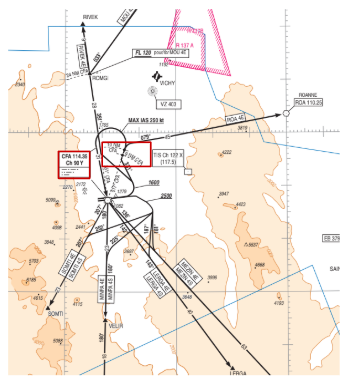
In the example above, the track is defined based on radials and distances from the CFA VOR.
The SID can otherwise be RNAV. Compared to conventional departures, RNAV departures require additional equipment: since the track is based on geographic coordinates, it must be possible to determine one's position without relying on radio beacons.
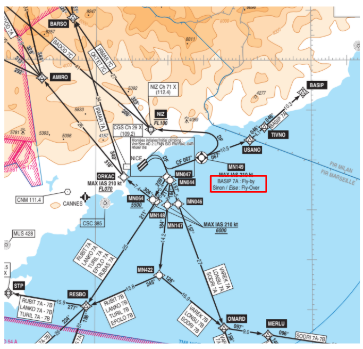
In the example above, the track is not defined based on a radio navigation aid. There are therefore only points called FIXs with geographic coordinates. The tracks of RNAV procedures also allow more freedom in their design, since we can introduce Directs/radius to FIX and other maneuvers that would be impossible if we were relying on a NAVAID.
These procedures do however require RNAV capabilities on the part of the aircraft (indicated in the PBN/ field of the flight plan).
Large French platforms such as Paris CDG, Paris ORY, and Nice have been stripped of their conventional departures, restricting them to RNAV departures. Aircraft bound for these platforms therefore require specific equipment in order to be able to land there. However, there can be exceptions, in which case radar vectoring is mandatory, both on arrival and on departure. In this second part, we will therefore look at departures by radar vectoring.
¶ Omnidirectional departure
The omnidirectional departure is the second possibility for IFR departures. This procedure, unlike the SID, does not include a track described from the runway to the first en-route point. In controlled airspace, use may be made of radar vectoring provided by the Radar Controller (APP/DEP); all restrictions relating to radar vectoring then apply. In uncontrolled airspace, specific instructions are published in the form of recommended instructions on the chart for the aerodrome in question.
For more information on radar vectoring, please refer to the following sheet: Radar vectoring
The omnidirectional departure is used:
- When no standard departure allows the first en-route point to be reached;
- When the traffic cannot follow the initially cleared departure;
- On the initiative of the air traffic control service.
Omnidirectional departures can sometimes already be published in specific charts or in SOPs for controllers. However, given the greater workload they involve for a radar controller, it is necessary to systematically coordinate them.
During this coordination, the Tower (Vigie) and Radar controllers agree on a heading and an initial altitude. Once on the Radar frequency, the traffic receives radar vectoring up to the first point of its route.
To find the phraseology associated with this type of clearance, please refer to the Phraseology manual.