
¶ Sequencing principles
¶ Introduction
Arrivals can come from the "four corners of the world," however it must be possible to organize these flows to allow them to land safely and on the same runway.
It is thus said that it is necessary to create the approach sequence, that is to say to achieve a regular flow of arrivals from different arrival flows. Sequencing is a teamwork effort between approach and en-route controllers that is absolutely necessary for the success of arrivals management.
¶ Planning your sequence plan
In order to produce as efficient a sequence as possible, thinking about and anticipating the situation in advance is absolutely necessary.
¶ Estimated time over a point
It is possible, on EuroScope, to display, for a traffic, an estimate of the arrival time over a point. To do this, simply left-click on its current altitude.
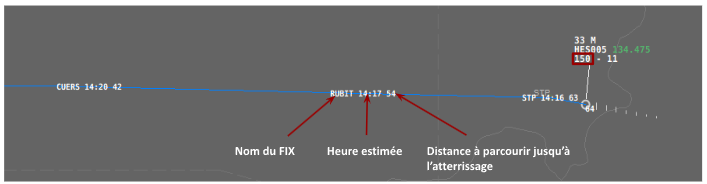
Example: Thanks to this tool, we can determine that HES005 will pass overhead RUBIT at 14:17z, and with this information, we can therefore decide whether it will pass before or after another traffic.
¶ Positioning range rings
Range rings are a second tool helping to define priorities. As their name indicates, these are distance circles around a given center.
They are activated using the command .rings [center] [distance] [number]
- [center]: Any point defined in the sector file (Airport, Fix, VOR, NDB, …) or coordinates if written in the correct format.
- [distance]: Number rounded to the nearest tenth of the distance between each circle.
- [number]: Whole number specifying the number of circles to display
Example: .rings BISBO 8 5 (5 circles spaced 8 Nm apart centered on BISBO)
The presence of two traffics on the same circle indicates that they are at the same distance from the center, so they are not separated, and action must be taken to create it.
¶ Aircraft category
In order to avoid surprises, it is important to check aircraft types. Indeed, the minimum separation between two aircraft varies depending on their weight class.
Moreover, the aircraft category is a good indicator of the traffic's final approach speed. Whereas a HEAVY can have an approach speed of 140 kts, a light aircraft may have one lower than 100 kts. Since these speed differences can reduce a separation very quickly (reminder: a difference of 60 kts is equivalent to the loss of 1nm of separation every minute), it is therefore necessary to take this information into consideration.
¶ Traffic speed
The instantaneous speed of traffic plays a key role in sequence planning. Indeed, even though a traffic may be closer to the approach, if it has a noticeably lower speed than a second traffic that is a bit further away, it may be preferable to let the faster traffic go first.
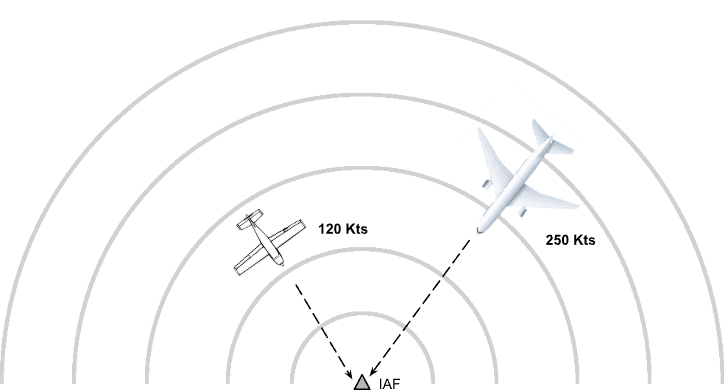
In this type of situation, the use of speed vectors is essential to help with visualization.
¶ Adjusting the sequence
¶ Sequencing methods
¶ Simple vectoring
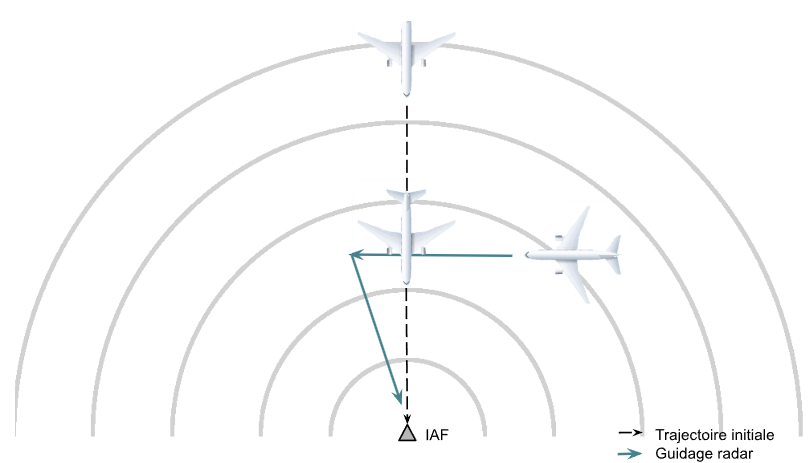
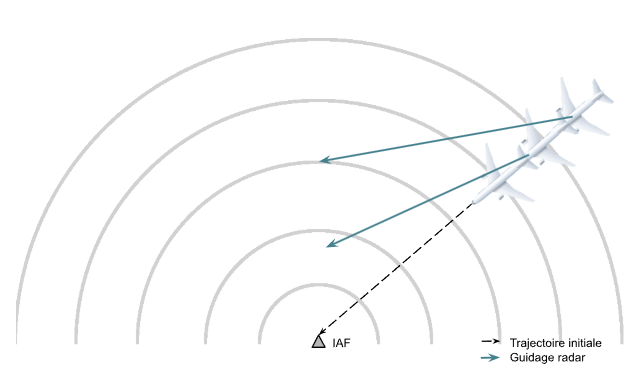
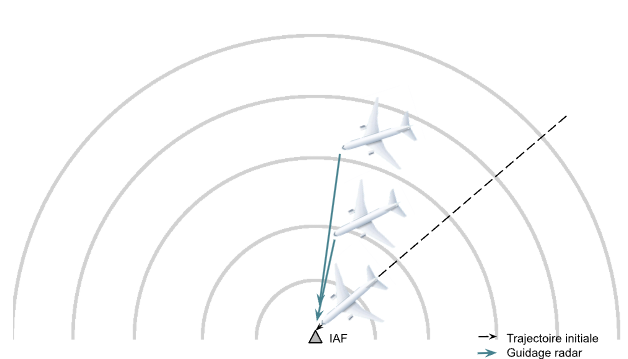
Radar vectoring can be used to decrease or increase the distance the traffic must cover. With good mastery of this technique, you can manage to interleave traffic among others, allowing the flows to be merged.
Example 1 :
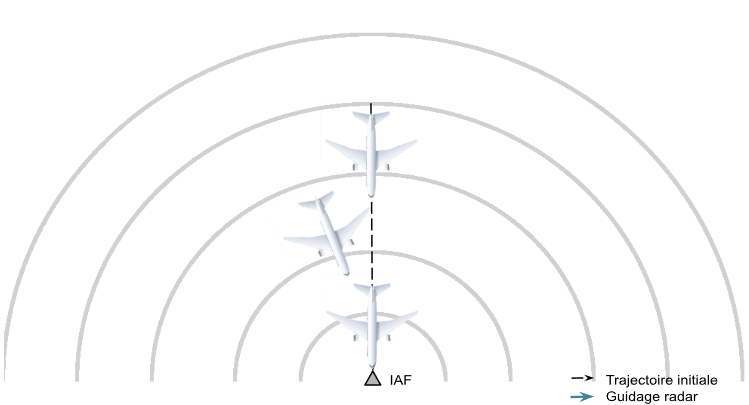
Example 2 :
¶ The point merge
Another extremely reliable and efficient technique is the "point merge". This technique becomes fully effective when used together with range rings: when the two traffics are separated by a circle, they can then be cleared direct to the merge point.
¶ Speed management
Finally, creating and maintaining a sequence necessarily requires managing the speed of the traffic concerned.
As a reminder, the knot speed unit is the ratio of the number of nautical miles to time. It is therefore possible to calculate the number of nautical miles covered based on time and speed: Kts = Nm / Hour
- 250kts → 250 Nm/H, i.e. 4.2 Nm / Min
- 220kts → 220 Nm/H, i.e. 3.7 Nm / Min
- 180kts → 180 Nm/H, i.e. 3 Nm / Min
Moreover, a difference of 30 kts is equivalent to a gain/loss of 1 Nm every 2 minutes, and a difference of 60 kts to a loss/gain of 1 Nm every minute.
For more information, see the sheet on Speed Control.