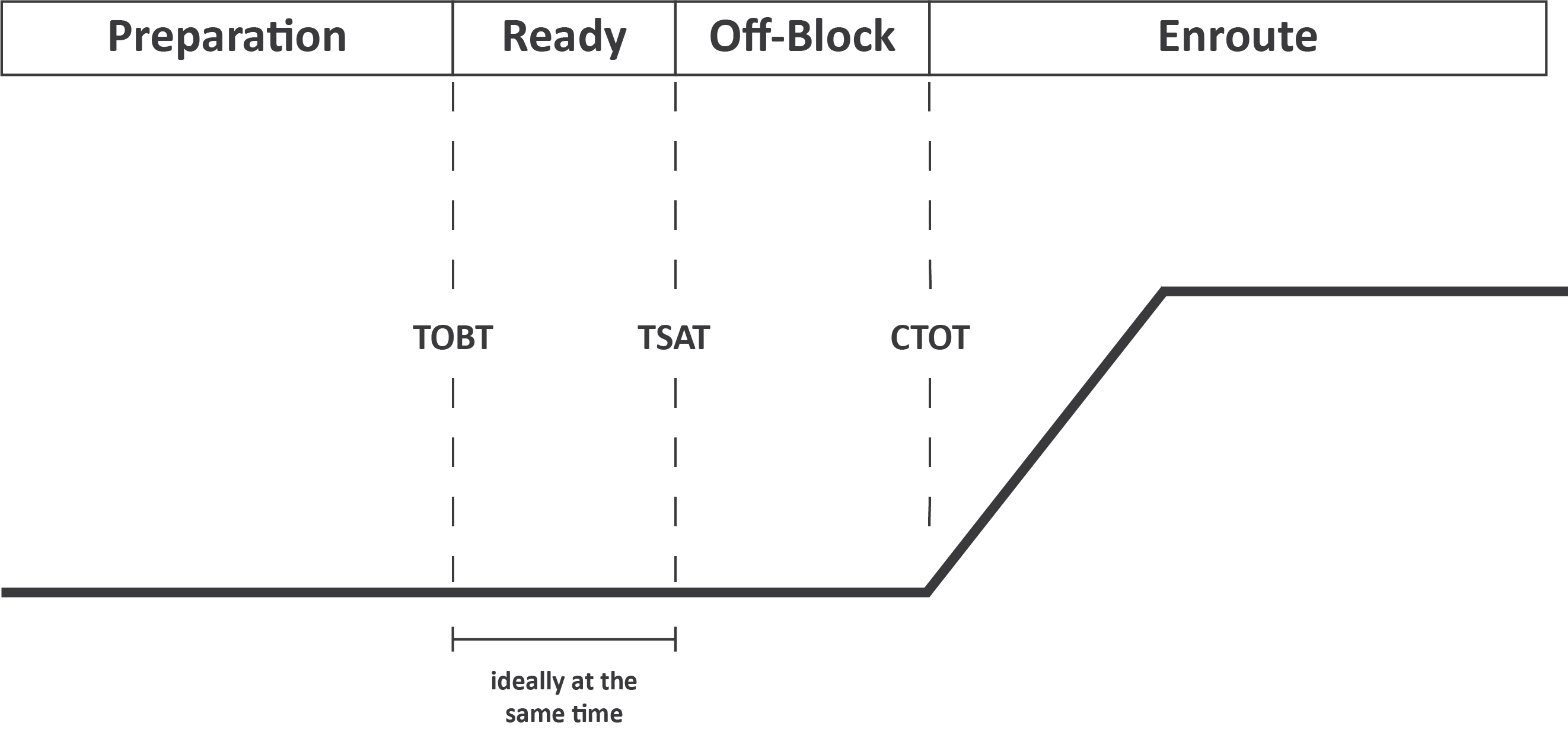
Airport Collaborative Decision-Making (A-CDM) improves the predictability and efficiency of airport operations through the exchange of accurate and up-to-date information between operational stakeholders.
The shared information is used to establish a coordinated departure sequence and calculate target times for the principal stages of the departure process, including start-up, off-block and take-off.
On VATSIM, A-CDM is simulated using the CDM plugin. Some elements are simplified to suit the virtual environment. The system:
Improves departure planning and sequencing;
Reduces unnecessary delay at holding points;
Coordinates start-up and off-block times; and
Integrates local departure planning with VATSIM ATFCM measures.
A-CDM procedures apply at the following aerodromes:
Operational requirement
Controllers should apply A-CDM procedures at all designated aerodromes, including when providing top-down coverage, provided that traffic levels and controller workload permit.
During events, A-CDM procedures shall be applied at all designated aerodromes and shall not be suspended or discontinued unless instructed by the Flow Management Position (FMP).
The distinction between A-CDM and non-A-CDM aerodromes concerns how the local departure sequence is planned:
ATFCM measures apply at both types of aerodrome. A restriction affecting a traffic flow may result in a CTOT whether the departure aerodrome is A-CDM or non-A-CDM. Every assigned CTOT shall therefore be observed independently of the local departure-planning method.
The A-CDM process coordinates the aircraft’s planned off-block time with the available airport and network capacity.
The departure sequence is built progressively:
The flight-plan EOBT provides the initial planning time.
The pilot confirms or updates the TOBT to indicate when the aircraft will actually be ready to leave the stand.
The CDM system combines the TOBT with the EXOT, runway capacity, any ATFCM restriction and other operational constraints to calculate the TTOT and TSAT.
Actual milestone times, such as ASRT, ASAT and AOBT, show how the flight is progressing against the plan and give all controllers the same operational picture.
Because the sequence is recalculated whenever one of its inputs changes, target times may move as aircraft become ready, runway demand changes or a network restriction is revised.
Within the simulated A-CDM process, the start-up approval window extends from TSAT −5 minutes to TSAT +5 minutes. The aircraft should be ready to receive start-up approval during this window.
Target times describe the plan; actual times record what has happened. The principal actual milestones used by controllers are:
Important
A TTOT supports local departure sequencing and may change as the traffic situation develops. A CTOT is an ATFCM restriction and its tolerance window shall be observed.
In an unconstrained situation, the CDM system aims to keep the TSAT close to the TOBT. The simplified relationship between the principal target times is:
The first calculation estimates when the aircraft would reach the runway if it left the stand at its TOBT. The system then checks whether that take-off time can be accommodated by the departure sequence.
The runway capacity is defined for successive time periods. If the initial TTOT falls in a period that has reached its departure capacity, the system moves the flight to the next available position and recalculates its TSAT. The difference between the TOBT and a later TSAT is the start-up delay.
Holding this delay at the stand controls the flow towards the runway, reduces unnecessary queues at the holding point and preserves the planned departure rate. A start-up delay is therefore a sequencing measure, not an indication that start-up has already been requested or approved.
Continuous runway supply
A-CDM regulates the queue; it does not aim to eliminate it. Several aircraft may intentionally be present at the runway holding point at the same time so that the runway remains continuously supplied and available departure capacity is not lost. The presence of multiple aircraft at the holding point does not, by itself, indicate that the CDM sequence is malfunctioning.
When a flight has a CTOT, the local sequence must also place its take-off within the applicable CTOT tolerance window. The CDM system works backwards from the suitable take-off position using the EXOT and any additional operational time to calculate a compatible TSAT.
The local TTOT may change as the sequence develops, but the currently assigned CTOT remains applicable until it is revised or cancelled by the ATFCM system.
The CDM sequence supports compliance with an ATFCM restriction but does not replace it. When a CTOT has been assigned, take-off shall occur within the applicable tolerance window:
CTOT −5 minutes to CTOT +10 minutes
ATC shall not permit the aircraft to take off outside this window. If the current sequence can no longer deliver the aircraft within it, a revised CTOT shall be obtained before departure.
A confirmed and accurate TOBT allows the system to give the flight a meaningful place in the sequence. If the aircraft will not be ready at its TOBT, that time shall be updated rather than allowing the TSAT to expire.
When the pilot reports ready, the ASRT records that request. It does not override the sequence: start-up approval remains tied to the applicable TSAT window and any CTOT constraint. Changes to TOBT, runway configuration, capacity, de-icing time or ATFCM status may cause the system to recalculate the TSAT and TTOT.
For the controller actions associated with these times, refer to A-CDM Operations.